
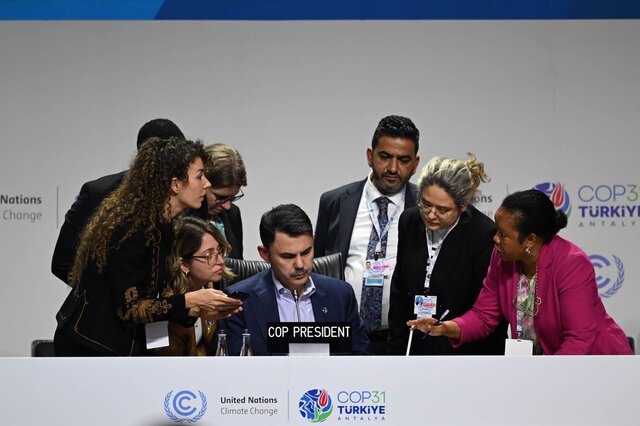
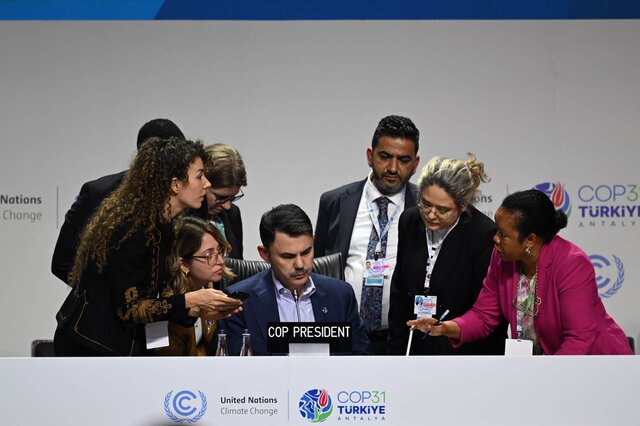
COP31 President and Turkish Environment Minister Murat Kurum (center) at the conference’s closing plenary session, November 22, 2026
The world’s leading climate summit has ended in Turkey: the 31st Conference of the Parties to the U.N. Framework Convention on Climate Change, or COP31. The conference ran for two weeks, beginning November 9, and brought together delegations from nearly 200 countries. It ended in failure: countries were unable to agree on the text of the Antalya Pact, the summit’s key agreement, which was supposed to set out shared goals, The Guardian reports.
The draft was rewritten several times in search of a compromise, but even the third version failed to satisfy some delegations. At the last minute, the European Union, the United Kingdom, and several developing countries opposed the final document. Their main objection was that the text made no mention of a goal to phase out fossil fuels.
Including such a provision in the pact, however, risked a veto from influential energy producers, particularly Saudi Arabia.
Speaking on behalf of the European Union at the closing session, Irish Environment Minister Darragh O’Brien said the proposed agreement “does not meet the moment”:
We will not endorse a decision that fails to reflect the science and risks widening the gap between global commitments and the action needed. [It] does not even mention fossil fuels, a key driver of climate change.
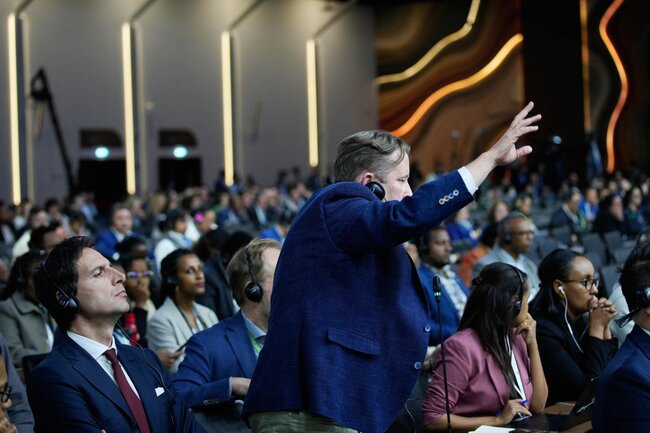
Irish Environment Minister Darragh O’Brien at the conference’s closing plenary session, November 22, 2026
Representatives of Panama, the Marshall Islands, and Norway also publicly opposed the agreement.
The Antalya Pact was supposed to be finalized on Friday, November 20. But negotiations dragged on, and by Sunday afternoon, November 22, it was clear that the document prepared by the Turkish and Australian delegations chairing the summit would not win consensus among participants.
The text did contain provisions that all countries were prepared to accept. These included a call for governments worldwide to electrify their economies and minimize any overshoot of the Paris Agreement’s 1.5°C global warming threshold, as well as a demand that wealthy nations provide financial support to help poor communities adapt to the effects of the climate crisis.
But language calling for a “transition away from fossil fuels,” demanded by more than 130 countries, never made it into the pact.
The text also contained controversial provisions on carbon capture and storage (CCS), a technology that activists say perpetuates fossil fuel use. Saudi Arabia’s delegation supported including CCS in the agreement. Other countries, including a group of African nations, China, and Pakistan, also had no objection to that compromise.
CCS is a process in which carbon dioxide is separated from industrial sources or the air and stored underground in geological formations. On the one hand, the technology helps reduce emissions in industries where quickly abandoning fossil fuels or high-temperature processes is difficult, such as cement production, metalworking, and chemical manufacturing. On the other hand, deploying CCS requires energy-intensive capture facilities, substantial spending, and transportation infrastructure. Skeptics argue that it ultimately slows the outright phaseout of fossil fuels.
Organizers said COP31 avoided a complete collapse thanks to separate agreements on narrow, uncontroversial issues, such as a “just transition” to a low-carbon economy for high-tech industries.
Still, the central failure remained. Turkish Environment Minister Murat Kurum, who chaired the summit, said organizers had “done everything possible” but ultimately “did not force this text on anyone or issue a ‘take it or leave it’ ultimatum.”
Australian Climate Change Minister Chris Bowen said he had not slept for three days: “Unfortunately, we were unable to reach an agreement, and that is deeply disappointing.”
Nongovernmental organizations that also took part in the COP31 negotiations criticized the summit. On November 20, Mohamed Adow, director of the think tank Power Shift Africa, said: “The chairs want to tell us this was a great conference. Well, I can say with absolute confidence that this was the worst COP in history.”
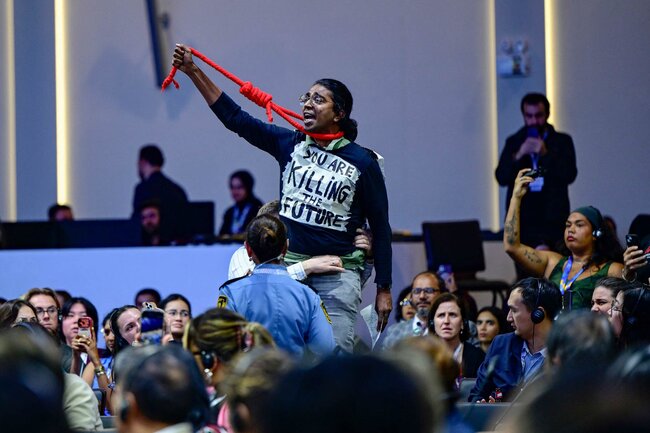
An activist protests COP31 participants’ inadequate action on climate change, November 20, 2026
On November 22, Adow also criticized the EU: “The EU rejected the text, but it cannot wash its hands of the destruction it helped create <…> For countries facing crop failures, destroyed homes, and mounting debt, [the failure to sign the Antalya Pact] amounts to a betrayal by the wealthy countries most responsible for the crisis.” In his view, “Europe’s hypocrisy is staggering: its governments demand that others develop fossil fuel development strategies while increasing their own production.”
COP31’s failure is especially stark against the backdrop of worsening extreme weather worldwide in 2026, which has claimed tens of thousands of lives. Causes included extreme heat, major disasters such as a glacier collapse in Nepal, and droughts and floods intensified by an exceptionally strong El Niño.
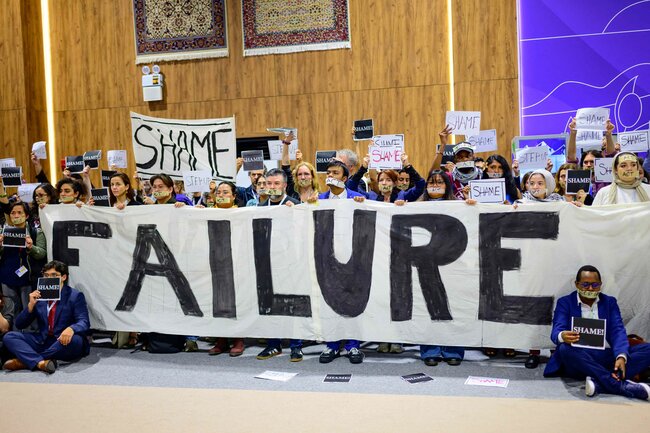
“Failure”: a banner activists unfurled outside the hall hosting COP31’s plenary session on November 20, 2026
Against this backdrop, the stalled climate talks shocked even veteran participants. Former Irish President and former U.N. Special Envoy on Climate Change Mary Robinson said: “There is no sense of urgency in addressing these problems. I find that deeply upsetting.”