
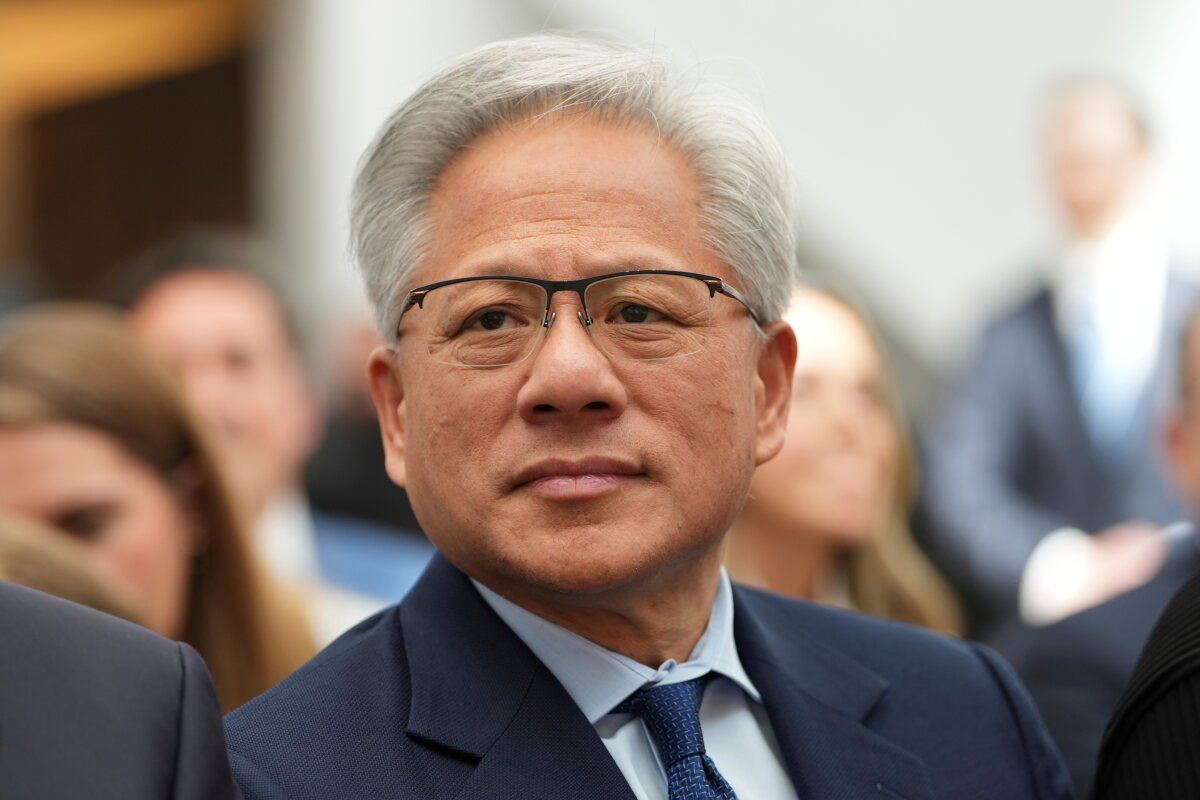
Nvidia CEO Acknowledges Affair Amid Chinese Espionage Allegations. Will Wall Street Punish the Stock on Monday?
A secret relationship, allegations of Chinese intelligence involvement, and an inquiry at the world's most valuable company. Nvidia CEO Jensen Huang has acknowledged being unfaithful to his wife as the company's board examines whether he was targeted by a foreign intelligence operation. Investors now face a question: Could the scandal shake Nvidia's stock when markets open Monday?
November 8, 2026 | NEWSruDaily | Business & Technology
A personal relationship involving one of Silicon Valley's most influential executives has developed into a national security controversy.
On Sunday, Nvidia announced an independent investigation after reports that its founder and CEO, Jensen Huang, had been targeted by a foreign intelligence operation.
The announcement came after reporting by The New York Times alleging that Huang had maintained a close relationship with a Chinese business executive whom U.S. intelligence officials reportedly identified as someone collecting information for Beijing.
Huang acknowledged being unfaithful to his wife and apologized to his family and colleagues.
But for Nvidia, a company at the heart of the global artificial intelligence boom, the controversy now reaches far beyond the CEO's personal life.
The Woman, the Intelligence Allegations, and $4.8 Billion in Chips
According to The New York Times, the woman at the center of the allegations is Alice Huang, a Chinese business executive previously associated with Singapore-based data center company Megaspeed.
Despite having the same surname, Alice Huang and Jensen Huang are not related.
U.S. intelligence officials reportedly believe she was recruited to collect information for Beijing and potentially influence decisions involving access to advanced American AI chips.
Megaspeed, a major Nvidia customer in Southeast Asia, reportedly purchased more than $4.8 billion worth of Nvidia chips over two years.
That business relationship makes the allegations particularly sensitive.
Washington has imposed restrictions on exports of advanced semiconductors to China, citing concerns that the technology could bolster Chinese military and intelligence capabilities.
However, the intelligence allegations have not been established as proven criminal wrongdoing in the publicly available reporting. Nor is there any confirmed finding that Alice Huang obtained Nvidia trade secrets through the relationship.
Nvidia Launches an Independent Investigation
In its November 8 statement, Nvidia's board announced that independent directors, supported by outside legal counsel, would examine the reports.
The board stressed that it currently has no reason to believe either U.S. national security or Nvidia's confidential information was compromised.
It also voiced confidence in Huang and his leadership team.
Huang, who has led Nvidia since founding the company in 1993, has pledged to cooperate fully and remain CEO during the investigation.
In a message to employees, he acknowledged his personal misconduct.
“I was unfaithful to my wife,” Huang wrote, according to reporting obtained by The Associated Press.
The admission is significant, but it must be distinguished from the espionage allegations.
Huang has acknowledged an extramarital relationship. That does not establish that he knowingly aided a foreign intelligence service or disclosed confidential information.
Congress Wants Answers
The controversy has already reached Capitol Hill.
On November 4, senior Republican lawmakers from three House committees asked Huang to participate in a closed-door briefing on November 18.
The request came from House Foreign Affairs Committee Chairman Brian Mast, China Select Committee Chairman John Moolenaar, and House Intelligence Committee Chairman Rick Crawford.
Lawmakers are seeking answers about Huang's reported interactions with Alice Huang and Nvidia's safeguards against foreign espionage.
Their concern goes beyond one executive's personal judgment.
Nvidia's processors are essential to the development of advanced AI systems, making access to its technology a strategic issue in the intensifying competition between Washington and Beijing.
The congressional scrutiny means Nvidia may face political and regulatory questions even if its internal investigation finds no loss of company secrets.
Will Nvidia Stock Fall on Monday?
Wall Street's first regular trading session after Sunday's announcement begins November 9.
The timing could scarcely be more sensitive.
Nvidia shares have already experienced volatility amid wider concerns about AI valuations, infrastructure spending, and the sustainability of the technology sector's extraordinary growth.
The new investigation adds another uncertainty: leadership risk.
Jensen Huang is not an interchangeable executive. He is the founder, public face, and longtime strategic leader of Nvidia.
Investors may therefore respond more strongly to allegations involving Huang than they would to a similar controversy involving a less central corporate figure.
Three possible outcomes deserve attention.
A negative opening: Investors could sell shares as they weigh the possibility of additional disclosures, congressional scrutiny, or reputational damage.
A limited reaction: The market could conclude that the investigation does not materially affect Nvidia's operations, particularly because the board has voiced confidence in Huang.
A volatile session: Shares could drop initially and recover, or move sharply in either direction as new information emerges.
Importantly, the announcement has not established that Nvidia lost intellectual property, violated export restrictions, or faces an imminent leadership change.
Without such findings, forecasting a specific percentage decline would be speculation.
The real market risk is not simply the affair. It is the possibility that investigators discover a deeper security problem.
Trump Weighs In
President Donald Trump also addressed the controversy on Sunday.
Speaking to reporters, Trump praised Huang's leadership and said he hoped everything would turn out well.
He indicated that he had not spoken with Huang about the latest developments.
Trump's response is notable because Nvidia holds a central position in U.S. technology policy, particularly regarding advanced AI chip exports and competition with China.
Secretary of State Marco Rubio declined to comment on the intelligence-related allegations.
A Personal Scandal With Global Consequences?
The case highlights a vulnerability that cybersecurity systems alone cannot eliminate: the possibility that personal relationships can become channels for foreign intelligence collection.
For Nvidia, the immediate challenge is to determine whether any confidential information was exposed while reassuring shareholders, customers, regulators, and employees.
For investors, the questions are just as direct.
Can Huang continue leading the company without disruption? Will the investigation reveal a material security failure? And could the controversy influence Washington's treatment of Nvidia's international business?
For now, the board supports Huang, no compromise of company secrets has been confirmed, and the investigation is still ongoing.
One of the world's most valuable technology companies is now facing a question no AI model can answer with certainty: How much damage can a CEO's private relationship do to a global business?
Monday's stock market reaction may provide the first indication of how seriously investors view the scandal.
But the ultimate consequences will depend on what the investigation reveals.
What do you think? Will Nvidia shares fall on Monday, or will investors look past the controversy?
Join the discussion at NEWSruDaily.com.
NEWSruDaily | Business & Technology
Sources: Nvidia Board of Directors statement, November 8, 2026; Reuters, November 5 and 8, 2026; Associated Press, November 8, 2026; The New York Times reporting.