
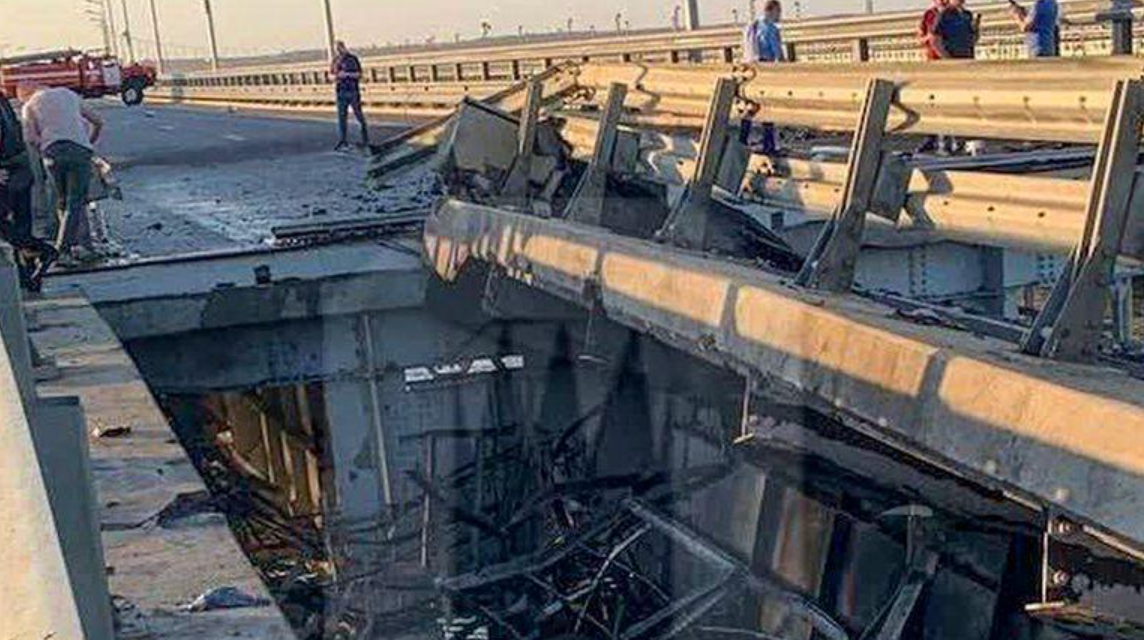
KYIV — Ukraine has delivered one of its most significant strikes against Russian infrastructure in months, destroying a major section of the bridge connecting Russia to occupied Crimea just days before Vladimir Putin's planned meeting with Donald Trump and Xi Jinping in China.
The attack, carried out over November 16 and 17, caused part of the Kerch Bridge's roadway to collapse into the sea, severely disrupting a transport route that Russia has relied on since its annexation of Crimea in 2014.
Images and videos verified by Reuters showed extensive damage, including a collapsed central road arch.
The strike represents both a military setback for Moscow and a symbolic challenge to Putin.
Why Is This Bridge So Important?
The 12-mile Kerch Bridge connects mainland Russia with the Crimean Peninsula.
Opened by Putin in 2018, it became a symbol of Moscow's control over territory internationally recognized as Ukrainian.
More importantly, the bridge has served as a major transportation route for vehicles, passengers and supplies.
Ukraine has repeatedly targeted the crossing since Russia launched its full-scale invasion in 2022.
Previous attacks damaged the structure, but the latest operation appears to have caused particularly extensive destruction to its roadway.
How Ukraine Carried Out the Attack
Ukrainian President Volodymyr Zelensky said the operation involved domestically developed drones and several types of missiles.
According to Ukrainian officials, Palianytsia drones targeted the road section, while Neptune and other missiles struck the railway infrastructure.
The operation reportedly followed weeks of attacks intended to weaken Russian air defenses around Crimea.
Russia acknowledged the damage and began assessing reconstruction requirements.
Rail service resumed on one track, but the road crossing remained unusable following the strike.
A Political Message Before the Summit
The timing is difficult to ignore.
Putin is preparing to meet Trump and Xi in Shenzhen, where the war in Ukraine is expected to feature prominently in diplomatic discussions.
The bridge attack demonstrates that Kyiv retains the ability to strike strategically important Russian-controlled infrastructure despite continued pressure on the battlefield.
It also complicates Moscow's efforts to present its military position as secure.
For Ukraine, the operation carries a clear message: any diplomatic settlement must account for Kyiv's military capabilities and its continued resistance to Russian occupation.
What Happens Now?
Russia faces the immediate challenge of restoring transport connections while protecting remaining infrastructure from further attacks.
Ukraine, meanwhile, may seek to exploit the disruption by increasing pressure on Russian supply routes.
The destruction of the roadway does not mean Crimea has been completely isolated. Russia retains other transport options, including routes through occupied southern Ukraine.
But the loss of a major crossing creates logistical difficulties and carries considerable political significance.
As world leaders prepare to discuss the war's future, Ukraine has ensured that the battlefield remains part of the conversation.