
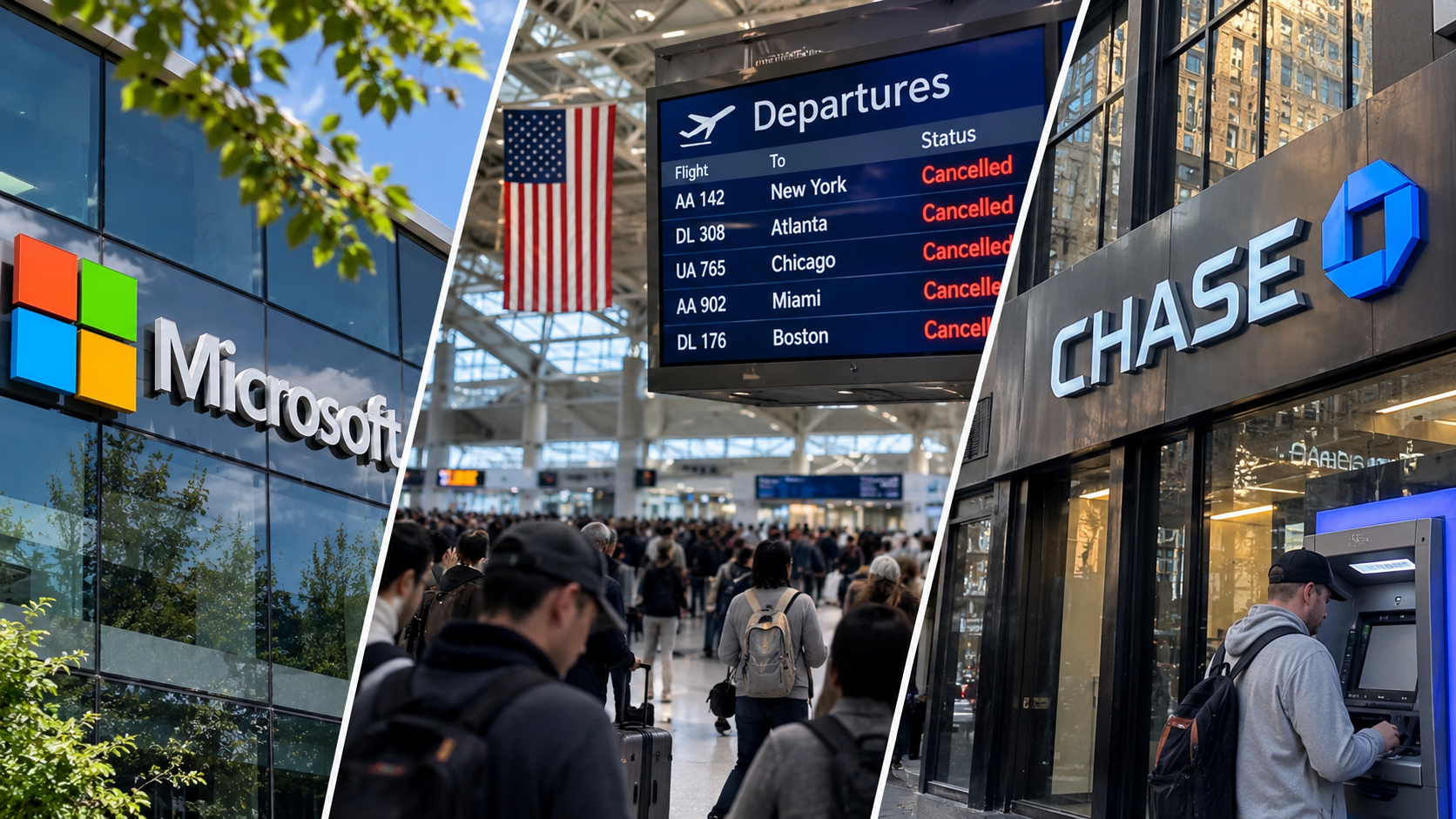
Three major technology failures in just five days. Email stopped working, flights were grounded, and Americans struggled to access banking services. Is this an extraordinary coincidence — or a warning about the vulnerability of America's critical infrastructure?
Why are essential systems so vulnerable? How effective are their backup systems? Who is responsible when they fail? And what is being done to prevent the next nationwide disruption?
These are questions Americans deserve answers to.
November 12: Microsoft Goes Down
A global Microsoft 365 outage disrupted Outlook, Teams, and other services, leaving businesses and individuals struggling to communicate and work.
Microsoft attributed the failure to a combination of software defects, increased traffic, and reduced server capacity. The company reported no evidence of malicious activity.
November 13: America's Airports Grind to a Halt
Just one day later, the Federal Aviation Administration (FAA) ordered a nationwide ground stop after technical problems disrupted air traffic communications and radar feeds.
Approximately 12,462 flights were canceled that Friday, although not all cancellations were directly caused by the outage.
The FAA traced the instability to excessive network traffic affecting aging equipment during infrastructure work. Air traffic resumed after nearly five hours.
November 16: Major Banks Experience Disruptions
Then came the financial sector.
Customers reported problems with Chase, Wells Fargo, Bank of America, and other major banks. Some struggled to log in, check balances, or complete transactions.
JPMorgan Chase confirmed a software bug affecting transaction processing. Wells Fargo also acknowledged online banking problems.
The Chase malfunction delayed some payments involving other financial institutions, including Zelle transfers. However, not every bank reporting customer complaints experienced its own system failure.
Three Failures. Five Days. What Are We Missing?
Microsoft. Aviation. Banking.
Different industries. Different technical problems. Yet all three incidents exposed how quickly disruptions can spread through systems millions of Americans rely on.
So far, there is no verified evidence connecting these outages or suggesting a coordinated cyberattack.
But that doesn't make the situation any less concerning.
America's economy depends on complex, interconnected technology. A software defect can disrupt business communications. A malfunctioning network can ground aircraft. A banking error can delay transactions across multiple institutions.
The incidents also raise difficult questions about infrastructure maintenance, contingency planning, and accountability.
Is America Prepared for the Next Failure?
Officials and companies have offered technical explanations for the disruptions. There is currently no credible evidence that they are concealing a common cause.
But explanations alone are not enough.
Americans deserve to know whether existing safeguards are adequate, whether aging infrastructure is being modernized quickly enough, and how essential services will continue operating when technology fails.
Perhaps the biggest threat isn't a mysterious cyberattack. Perhaps it's how dependent we've become on systems that can fail without warning.
The question is no longer simply why these outages happened.
It's whether America is prepared for the next one.
NEWSruDaily | U.S. News • Technology • National Security
Sources: Reuters, Associated Press, Microsoft incident reporting, and the Federal Aviation Administration (FAA), November 12–16, 2026.