
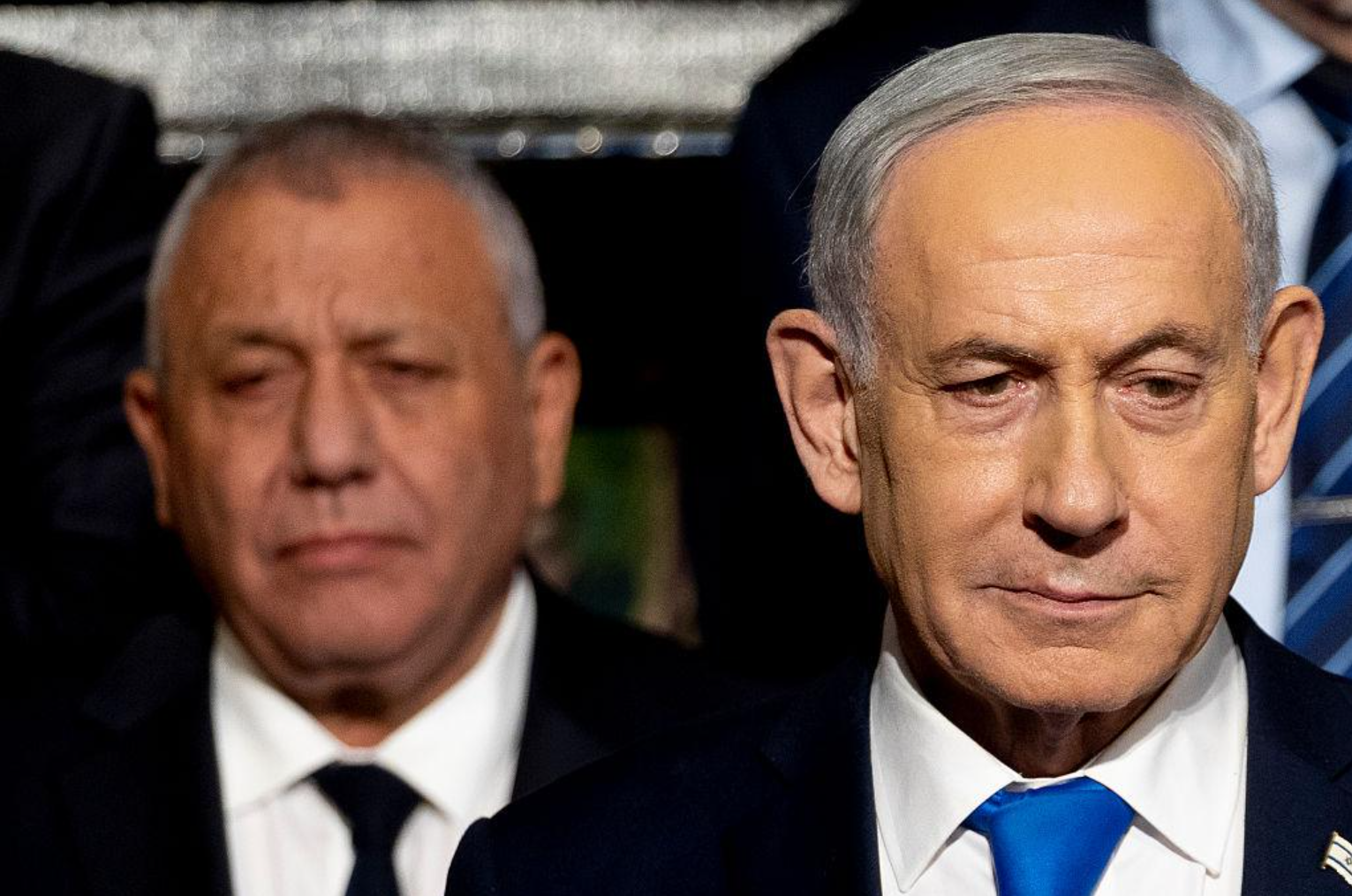
Netanyahu Loses His Majority: Who Will Lead Israel Next?
Benjamin Netanyahu has lost his parliamentary majority, but his political career is far from over. Following Israel's October 27 election, former military chief Gadi Eisenkot has been given the first opportunity to form a new government. The problem? His potential allies agree on removing Netanyahu from power — but not necessarily on what should happen afterward.
NEWSruDaily | Israel • Politics | November 13, 2026
Netanyahu Lost His Majority — But Not His Office
Israel is facing a political showdown after its parliamentary election left neither major political bloc with enough seats to govern independently.
Netanyahu's right-wing and religious alliance secured 53 seats in the 120-member Knesset, eight short of the 61 needed for an outright majority.
The opposition alliance led by Gadi Eisenkot won 48 seats, while Arab-led parties secured another 19.
Together, the parties opposed to Netanyahu control 67 seats. But their political differences make forming a unified government extraordinarily difficult.
For now, Netanyahu remains prime minister in a caretaker capacity while coalition negotiations continue.
Who Is Gadi Eisenkot?
Gadi Eisenkot is a former chief of staff of the Israel Defense Forces who led the military from 2015 to 2019.
He later entered politics and became a prominent figure in Israel's opposition.
Unlike some of Netanyahu's political opponents, Eisenkot brings extensive military and national security experience to his campaign for leadership.
His Yashar party and its allies have positioned themselves as an alternative to Netanyahu's long-standing political dominance.
On November 8, President Isaac Herzog formally tasked Eisenkot with forming Israel's next government.
The decision followed consultations in which parties representing 67 lawmakers recommended Eisenkot for prime minister, compared with 46 who backed Netanyahu.
But receiving the presidential mandate is not the same as securing a parliamentary majority.
The Numbers That Could Decide Israel's Future
The newly elected Knesset is divided into three major groups:
Netanyahu's right-wing and religious bloc: 53 seats.
Eisenkot's alliance and its Jewish-majority opposition partners: 48 seats.
Arab-led parties: 19 seats.
The arithmetic appears straightforward.
If Eisenkot could unite all 67 lawmakers opposed to Netanyahu, he would have a parliamentary majority.
Politically, however, the situation is much more complicated.
Several of Eisenkot's potential coalition partners have rejected the possibility of governing alongside Arab-led parties.
Others oppose cooperation with ultra-Orthodox religious parties.
This leaves Eisenkot with a difficult choice: compromise on major campaign promises or risk failing to form a government.
Three Possible Paths to Power
Option One: Cooperation With Arab-Led Parties
The Arab-led parties, which won a record 19 seats, could provide crucial support for a government led by Eisenkot.
However, some opposition leaders oppose bringing them into the coalition or relying on their votes.
Eisenkot has also condemned what he describes as Netanyahu's campaign against Arab citizens of Israel, arguing that political disagreements must not become attacks on an entire community.
On November 13, he accused Netanyahu and his allies of encouraging hostility toward Arab voters following the election.
Option Two: An Agreement With Ultra-Orthodox Parties
Eisenkot could attempt to persuade ultra-Orthodox parties to abandon Netanyahu and support a different government.
But this would require difficult negotiations over military service.
Exemptions from compulsory military service for ultra-Orthodox men have become one of Israel's most divisive political issues.
Eisenkot and several of his allies have campaigned for a more equal distribution of military obligations.
Reaching an agreement with religious parties could therefore require substantial concessions.
Option Three: A Unity Government With Netanyahu
A third possibility is a broad coalition involving both Netanyahu and Eisenkot.
Netanyahu has publicly called for national unity, while Eisenkot has indicated a willingness to consider cooperation across political divisions.
But the two leaders have sharply different political priorities.
A unity government would require agreement on leadership, security policy, judicial reforms and the future of Israel's political institutions.
Such an arrangement could also prove unstable.
Netanyahu Challenges the Election Results
Following the election, Netanyahu alleged irregularities involving Arab voters and Arab-led political parties.
Israeli election authorities have said they have not found evidence of fraud capable of changing the outcome.
The accusations have nevertheless intensified political tensions.
Eisenkot has condemned attempts to delegitimize Arab citizens and their political representatives.
The disagreement highlights a broader conflict over the role of Arab voters in determining Israel's political future.
Iran Adds Another Layer of Uncertainty
Israel's political negotiations are unfolding amid continuing regional security concerns.
Reports that Netanyahu is considering renewed military action against Iran have prompted warnings from Eisenkot, who has urged caution while the country operates under a caretaker government.
Eisenkot has argued that major security decisions should not be influenced by political calculations during the transition.
However, there is no established evidence that Netanyahu has ordered military action to interfere with the coalition-building process.
The tension illustrates how closely Israel's domestic political crisis is connected to its national security challenges.
What Happens Next?
Eisenkot initially has until December 6 to form a government.
President Herzog can grant a two-week extension, potentially moving the deadline to December 20.
If Eisenkot fails, Netanyahu could receive an opportunity to assemble his own coalition.
If neither leader succeeds, Israel could face another election.
For a country already dealing with years of conflict and political polarization, another electoral campaign could prolong uncertainty.
Is Netanyahu's Political Era Coming to an End?
Netanyahu has survived numerous political crises throughout his career.
Losing a parliamentary majority is a serious setback, but it does not automatically end his leadership.
His opponents have enough seats to challenge him, yet they remain divided over the compromises required to replace him.
Eisenkot has the first opportunity to form a government, but he must persuade parties with conflicting priorities to cooperate.
The biggest obstacle to replacing Netanyahu may not be Netanyahu himself. It may be the inability of his opponents to agree on what comes next.
Israel's next prime minister will not necessarily be determined by who won the most votes or who controls the largest individual party.
The decisive question is who can build a coalition capable of governing.
And until that question is answered, Netanyahu remains in office.
NEWSruDaily — Independent News Without Borders.
Sources: Reuters, Associated Press, The Times of Israel and The Jerusalem Post. Reporting through November 13, 2026.