
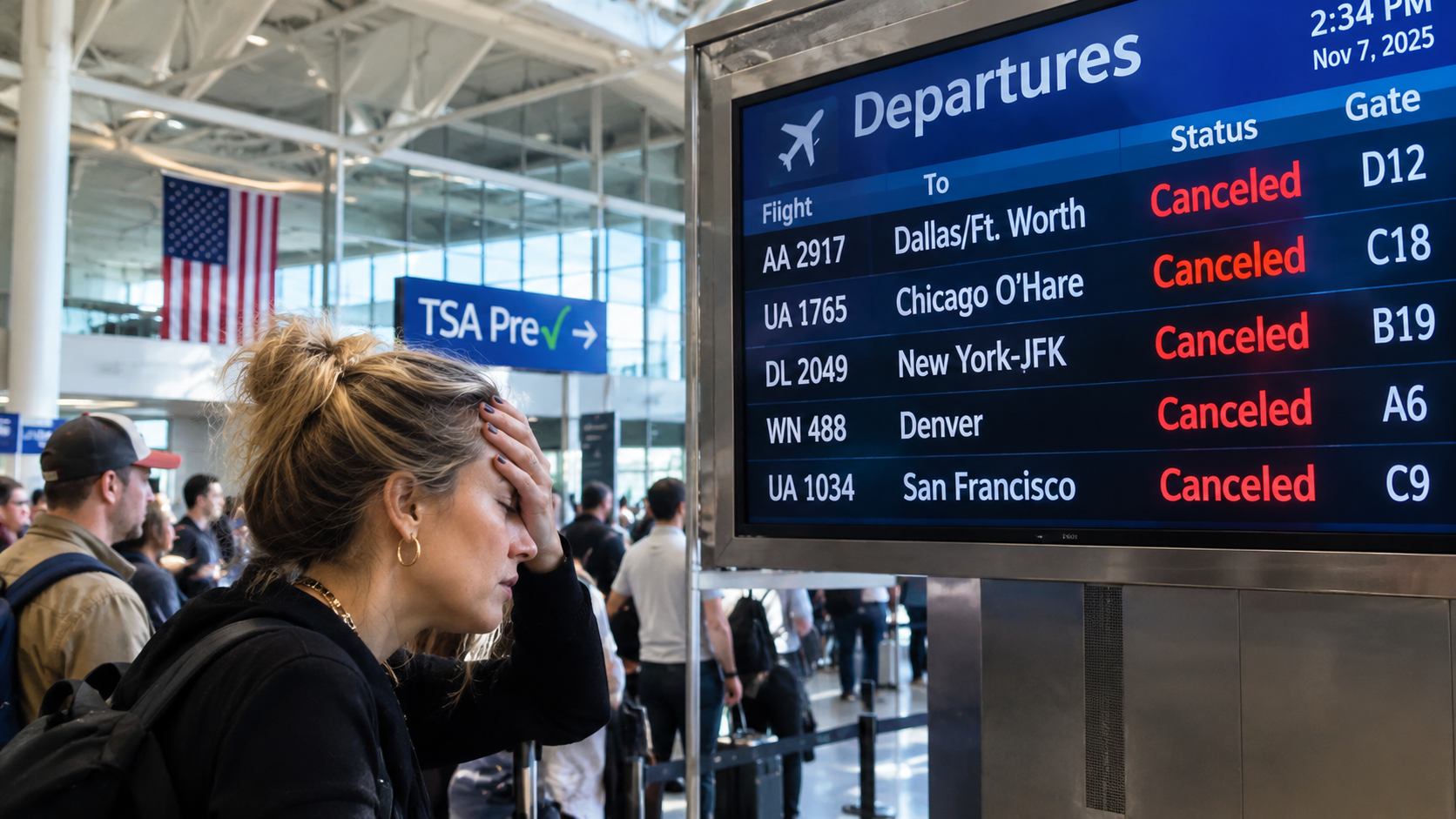
The US aviation system suffered one of its most serious disruptions in recent years. The Federal Aviation Administration (FAA) ordered a temporary nationwide halt to departures because of communication problems between air traffic control centers. Nearly 5,000 flights were canceled, leaving thousands of passengers stranded at airports. Restrictions were lifted in the evening, but the effects could linger for several days.
NEWSruDaily | US • Incidents • November 13, 2026
What happened?
On Friday, November 13, the Federal Aviation Administration announced an emergency halt to departures from US airports.
The shutdown was prompted by widespread problems with the communications system air traffic controllers use to coordinate aircraft movements.
According to US Transportation Secretary Sean Duffy, the problems affected regional air traffic control centers responsible for safely guiding planes between airports.
The FAA ordered departures suspended as a safety precaution.
Planes already in the air generally continued to their destinations. Departing flights, however, could not take off as usual.
The restrictions lasted more than four hours before the FAA allowed departures to resume.
Nearly 5,000 flights canceled
The technical outage had widespread consequences.
According to FlightAware, nearly 5,000 flights in the US had been canceled by Friday evening. Thousands more were delayed.
Hundreds of aircraft had to be diverted to other airports.
Passengers waited hours for information about their flights as airlines scrambled to adjust their schedules.
United Airlines and JetBlue announced they were canceling a significant share of their remaining evening flights. Air Canada also suspended some flights between Canada and the US.
Even after the restrictions were lifted, airlines could not quickly restore their schedules: Aircraft and crews were not where they needed to be under the original timetable.
Was it a cyberattack?
The widespread outage raised questions about possible hacking.
US authorities, however, said initial checks had found no signs of a deliberate attack.
Homeland Security Secretary Markwayne Mullin attributed the disruption to telecommunications problems.
Administration officials also pointed to overloaded and outdated equipment still in use in the US air traffic control system.
Experts have yet to determine the exact technical causes of the incident.
Why was US aviation so vulnerable?
The outage renewed scrutiny of the FAA's infrastructure.
Despite advances in artificial intelligence, automation and modern aviation technology, parts of the US air traffic control system still rely on equipment developed decades ago.
In 2025, Congress allocated $12.5 billion to modernize aviation infrastructure.
The work includes replacing old copper cables with fiber-optic lines and upgrading radio communications systems.
But Transportation Secretary Sean Duffy estimates that completing the modernization will require about $30 billion more.
The November 13 incident showed how serious the consequences of a technical failure can be in a system that millions of passengers depend on every day.
What should passengers do?
The FAA has lifted the nationwide restrictions, but airlines warn that delays and cancellations could continue into Saturday.
Passengers are advised to check their flight status directly on their airline's website before heading to the airport.
If a flight is canceled, the airline usually offers rebooking. Passengers whose flights are canceled may also be entitled to a ticket refund under current US rules.
Additional cash compensation depends on the circumstances and the airline's policies.
The big question: Could this happen again?
Nationwide departure halts are extremely rare in the US.
Similar restrictions were imposed in January 2023 after an FAA computer system failed.
The latest incident once again raises questions about the reliability of aviation infrastructure in the world's largest economy.
America is investing billions of dollars in artificial intelligence, space technology and unmanned systems. Yet on Friday, thousands of planes could not take off because of problems with a basic communications system.
That contrast could become a central argument for those calling for urgent FAA modernization.
As experts investigate the technical causes of the outage, passengers and airlines continue to deal with its aftermath.
NEWSruDaily — Independent News Without Borders.
Sources: Federal Aviation Administration (FAA), Associated Press, ABC News, FlightAware. Information current as of the evening of November 13, 2026.