
Why Are So Many Billionaires Married to Chinese Women? Is Western Feminism Driving Men Away?
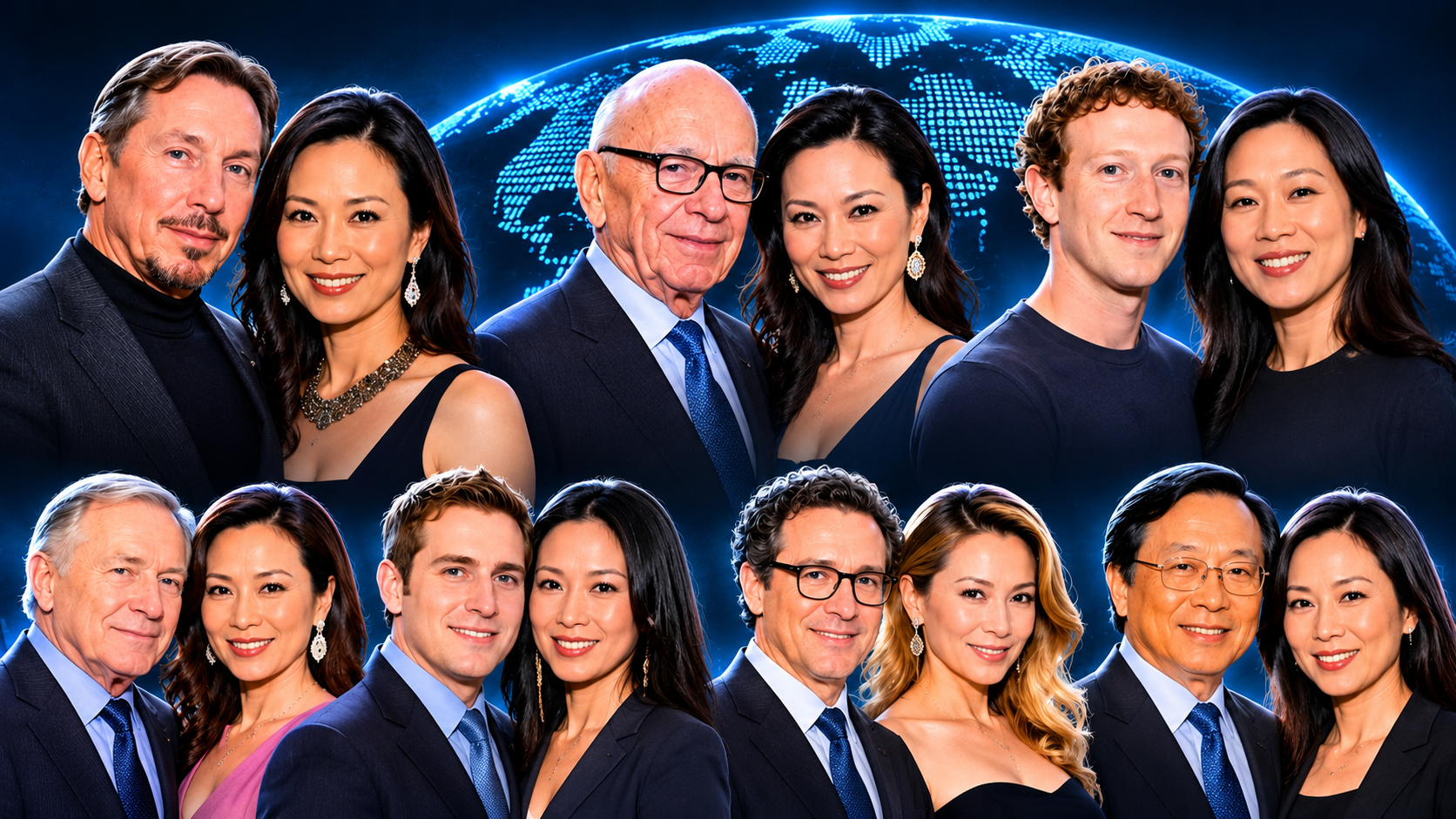
Eight powerful men. Eight women of Chinese descent. Billions of dollars, international empires, and one controversial question: Are some of the world's most successful men looking for something they believe Western relationships have lost?
NEWSruDaily | SPECIAL EDITION | Society & Relationships
Let's take a break from the political scandals, international conflicts, and endless controversies dominating the world's headlines.
Today, let's talk about something different.
Love. Money. Power. Marriage.
And a rather intriguing question:
Why have so many of the world's most successful businessmen married women of Chinese descent?
Larry Ellison. Mark Zuckerberg. Rupert Murdoch. Eduardo Saverin. Jean Todt.
Different industries. Different generations. Extraordinary fortunes.
Yet these men share something beyond their wealth and influence: they have all married women with Chinese roots.
Coincidence? Perhaps.
But let's ask a more provocative question.
Are some powerful Western men turning toward Asian women because they're tired of modern Western feminism?
Could traditional family values, emotional harmony, and different expectations of marriage be part of the attraction?
After all, imagine spending your entire day managing a multibillion-dollar empire, negotiating deals, making difficult decisions, and competing with some of the most powerful people on the planet.
Would you really want to come home to another power struggle?
Or would you prefer a partner who makes home feel like a refuge rather than another boardroom?
Of course, the assumption that Chinese women are naturally more accommodating is a stereotype, not a proven fact. And no one can determine why a particular man married his wife simply by looking at her ancestry.
But the questions surrounding marriage, feminism, cultural expectations, and power are worth exploring.
NEWSruDaily examines eight high-profile couples, the statistics behind interracial marriages, and the uncomfortable question of what successful men really want in a wife.
Eight Powerful Men and Their Chinese-Descent Partners
1. Larry Ellison and Jolin Zhu: The Oracle Billionaire
Larry Ellison, the billionaire co-founder of Oracle, is known for his competitive personality, extraordinary wealth, and decades of dominance in the technology industry.
His sixth wife, Jolin Zhu, was born in China and attended the University of Michigan.
Their relationship has attracted attention partly because of their substantial age difference.
Ellison has spent his career building an empire in an industry defined by competition.
Does a man who spends his professional life fighting for dominance seek something different in marriage?
Perhaps. But that remains a question, not an established explanation of his relationship.
2. Rupert Murdoch and Wendi Deng: Power, Ambition, and Marriage
Media mogul Rupert Murdoch married Chinese-born Wendi Deng in 1999.
Deng was educated in the United States and had a career in international media before their marriage.
Their relationship lasted 14 years, ending in divorce in 2013. Murdoch is now married to Elena Zhukova.
Deng became a prominent international figure in her own right.
Far from fitting the stereotype of a passive wife, she was ambitious, socially connected, and comfortable operating in powerful circles.
Their marriage raises a different question: Are powerful men necessarily attracted to submissiveness, or are they sometimes drawn to women who understand ambition as well as they do?
3. Hubert and Carrie Perrodo: A Family Fortune
French entrepreneur Hubert Perrodo founded the international oil company Perenco.
His wife, Carrie Perrodo, was born in Hong Kong and later became one of France's wealthiest women.
Following Hubert's death in 2006, the family's business interests continued under the next generation.
Their story illustrates the importance of family continuity and long-term financial legacy among wealthy international families.
For some entrepreneurs, stability and a shared vision of family may be particularly valuable.
But whether cultural traditions influenced this particular marriage is not publicly established.
4. Mark Zuckerberg and Priscilla Chan: Love Before the Billions
Mark Zuckerberg met Priscilla Chan at Harvard in 2003, long before Facebook became a global technology empire.
Chan was born in Massachusetts to ethnic Chinese parents who had fled Vietnam.
She became a pediatrician, and the couple married in 2012.
Together, they founded the Chan Zuckerberg Initiative, which supports scientific research, education, and other philanthropic projects.
Their story complicates the idea that billionaire men are searching for financially dependent women.
Priscilla knew Zuckerberg before his extraordinary wealth.
She has her own education, professional identity, and philanthropic ambitions.
Perhaps what matters in their relationship is not obedience, but a partnership built before fame and fortune changed their lives.
5. Jean Todt and Michelle Yeoh: When Both Partners Are Powerful
Former Ferrari executive Jean Todt married Malaysian-born actress Michelle Yeoh in 2023, after nearly two decades together.
Yeoh, who has Chinese ancestry, is an Academy Award-winning actress with a successful international career.
She has her own fame, financial independence, and professional achievements.
Does that sound like a woman who needs a powerful husband to define her identity?
Hardly.
Their marriage suggests that some influential men may be attracted to women who are equally accomplished.
6. Bruce Rockowitz and Coco Lee: Business Meets Stardom
Canadian businessman Bruce Rockowitz married singer Coco Lee in 2011.
Lee, an internationally recognized performer of Chinese descent, had an established entertainment career spanning Asian and Western markets.
She died in 2023.
Their relationship brought together two people with different careers and public identities.
Once again, the woman in the relationship was far from an anonymous figure living entirely in her husband's shadow.
7. Eduardo Saverin and Elaine Andriejanssen: A Global Partnership
Facebook co-founder Eduardo Saverin married Elaine Andriejanssen in 2015.
Elaine comes from an Indonesian family of Chinese descent, studied in the United States, and worked in finance.
Their marriage reflects the increasingly international nature of the world's business elite.
Successful entrepreneurs frequently study, work, invest, and socialize across national borders.
Meeting a partner from a different cultural background is hardly unusual in such an environment.
8. Sehat Sutardja and Weili Dai: Building a Technology Empire Together
Perhaps the most revealing example is the marriage of Sehat Sutardja and Weili Dai.
Dai was born in Shanghai and became a prominent American technology entrepreneur.
Together, they helped establish Marvell Technology, a major semiconductor company.
Sutardja died in 2024.
Weili Dai was not simply married to a successful technology founder.
She was one herself.
And that makes their story particularly interesting.
If the theory is that billionaire men marry Chinese women because they are less ambitious or more obedient, how does it explain a woman who helped build a technology empire?
It doesn't.
The Statistics: Is There Really a Pattern?
Now let's look beyond these eight marriages.
According to a Pew Research Center study published in 2017, using U.S. marriage data from 2015, Asian women were significantly more likely than Asian men to marry someone of a different race or ethnicity.
The figures were striking:
36% of newlywed Asian women married outside their racial or ethnic group.
21% of newlywed Asian men did the same.
Among interracial and interethnic newlywed couples, marriages between white men and Asian women were also more common than marriages between Asian men and white women.
This is a measurable difference, not simply a social-media impression.
But there are two important limitations.
First, the research covers Asian Americans broadly, not Chinese women specifically.
Second, it measures marriage patterns, not why people choose their partners.
It does not establish that most white men prefer Asian women, nor does it prove that feminism influences their choices.
Still, the numbers make the broader question worth examining.
Why do certain combinations of race, gender, and marriage appear more frequently than others?
Has Western Feminism Changed What Men Look for in a Wife?
Here is where the discussion becomes uncomfortable.
For decades, Western societies have encouraged women to become more independent, financially successful, and professionally ambitious.
Women have gained greater freedom to choose their careers, decide whether to have children, and determine what kind of marriage they want.
These changes have created opportunities that previous generations could only imagine.
But they have also transformed expectations inside relationships.
Who should be the primary breadwinner?
Who makes the final decisions?
Who sacrifices professional opportunities when children arrive?
And does equality mean that both partners must have exactly the same roles?
For some couples, these questions lead to productive conversations.
For others, they create conflict.
Now consider the life of a billionaire CEO.
A man who spends his days negotiating billion-dollar deals, managing executives, and navigating intense competition may place an especially high value on peace and emotional support at home.
He may not want a relationship that feels like another contest for control.
But does that mean he wants a submissive wife?
Not necessarily.
There is a difference between wanting a peaceful marriage and wanting a woman who never disagrees with you.
And there is an equally important difference between feminism, which advocates equality, and treating marriage as a competition.
Perhaps some men are reacting not to women's independence itself, but to relationship dynamics they perceive as adversarial.
That is a plausible hypothesis about individual preferences. It is not a demonstrated explanation for the marriages in this article.
The Chinese Wife: Traditional Values or a Western Fantasy?
Chinese culture has historically emphasized family obligations, respect for elders, intergenerational responsibility, and maintaining social harmony.
These values have influenced traditional expectations of marriage and family life.
In Western popular culture, however, those traditions can become exaggerated into a simplistic image of Chinese women as gentle, loyal, accommodating, and less confrontational.
For a man who wants a more traditional relationship, that image might appear attractive.
But is it accurate?
China has undergone enormous social and economic changes.
Chinese women are entrepreneurs, scientists, executives, investors, and political leaders. They pursue advanced education, build careers, and make independent decisions about marriage.
And Chinese women living in the United States, Singapore, Malaysia, or Europe may have very different experiences and expectations.
Being Chinese does not make a woman inherently more obedient, just as being Western does not make a woman inherently more confrontational.
Nevertheless, cultural expectations can influence attraction.
Some men may associate Chinese or other Asian backgrounds with traditional family values.
Others may be attracted to education, ambition, shared interests, or individual personality.
And some may simply fall in love without considering ethnicity at all.
The interesting question is whether the perception of traditional femininity influences some men's dating choices, even when that perception does not accurately describe the women themselves.
Does a Billionaire Want an Equal Partner or Someone Who Lets Him Lead?
This may be the most provocative question of all.
Successful entrepreneurs are often accustomed to leadership.
They make decisions, accept risks, and expect results.
But marriage is not a corporation.
A wife is not an employee.
And a family is not a management team.
Still, couples have different preferences about leadership and responsibility.
Some prefer to divide decisions equally.
Others voluntarily adopt more traditional roles.
A woman may want a husband who takes primary responsibility for financial security while she focuses more on family life.
Another may want a demanding career and an equal division of domestic responsibilities.
Neither arrangement is automatically superior.
What matters is whether both partners genuinely agree.
But here is the contradiction worth discussing:
Modern culture celebrates women who refuse to be controlled. Yet it sometimes treats women who voluntarily prefer traditional relationships as though they have made the wrong choice.
Why?
Shouldn't genuine independence include the freedom to choose a traditional marriage?
And shouldn't a man be free to prefer traditional family roles, provided he respects his partner's autonomy?
Perhaps the real debate is not about Chinese women versus Western women.
Perhaps it is about whether society still knows how to distinguish equality from competition.
What If Powerful Men Aren't Looking for Obedience at All?
Consider the women in our eight examples.
Priscilla Chan is a physician and philanthropist.
Michelle Yeoh is an Oscar-winning actress.
Weili Dai helped build a semiconductor company.
Wendi Deng established an international business career.
Elaine Andriejanssen has a background in finance.
These women hardly fit a single stereotype of dependence or passivity.
So perhaps the attraction has less to do with submission and more to do with compatibility.
A successful man may value a partner who understands ambition without turning every disagreement into a struggle for dominance.
He may appreciate emotional stability, loyalty, family commitment, intelligence, and mutual respect.
And those qualities are not exclusive to Chinese women.
They are individual qualities that can be found in people from every background.
In fact, the most compelling examples in this group are not necessarily the marriages with the greatest differences in wealth or age.
They are the relationships in which both partners brought something substantial to the table.
NEWSruDaily's Take: Are Men Escaping Feminism, or Searching for Peace?
Eight prominent couples cannot tell us what all billionaires want.
And they certainly cannot prove that wealthy men are abandoning Western women because of feminism.
But these relationships offer a fascinating starting point for a larger cultural conversation.
Modern marriage is changing.
Women are redefining independence.
Men are reconsidering traditional expectations.
And couples everywhere are trying to determine how love, ambition, money, and family should fit together.
Perhaps some successful men are drawn to partners they believe share more traditional values.
Perhaps others prefer equally ambitious women who understand the pressures of success.
And perhaps the most important quality has nothing to do with nationality.
Maybe powerful men don't want a woman who agrees with everything they say.
Maybe they want a woman who is strong enough to disagree without making every disagreement a battle.
Likewise, perhaps successful women don't want men they can dominate.
Perhaps they want partners secure enough to appreciate their independence.
The real issue may not be whether Chinese women are more traditional or whether Western feminism has gone too far.
It may be whether modern relationships have become so focused on power and independence that some couples have forgotten how to cooperate.
Because a successful marriage is not necessarily one where both people insist on leading.
Sometimes, the strongest partnership is the one where neither person feels the need to win.
And that may be worth more than a billion dollars.
What Do You Think?
Are successful Western men increasingly attracted to traditional family values?
Has modern feminism made relationships more complicated?
Or are we looking for cultural explanations where the answer is simply love?
Join the conversation. NEWSruDaily wants to hear your opinion.
NEWSruDaily — Independent News Without Borders.
Research: Pew Research Center, Intermarriage in the U.S. 50 Years After Loving v. Virginia (2017), based on 2015 U.S. Census data.